How fast is too fast? Japan itinerary pacing guide
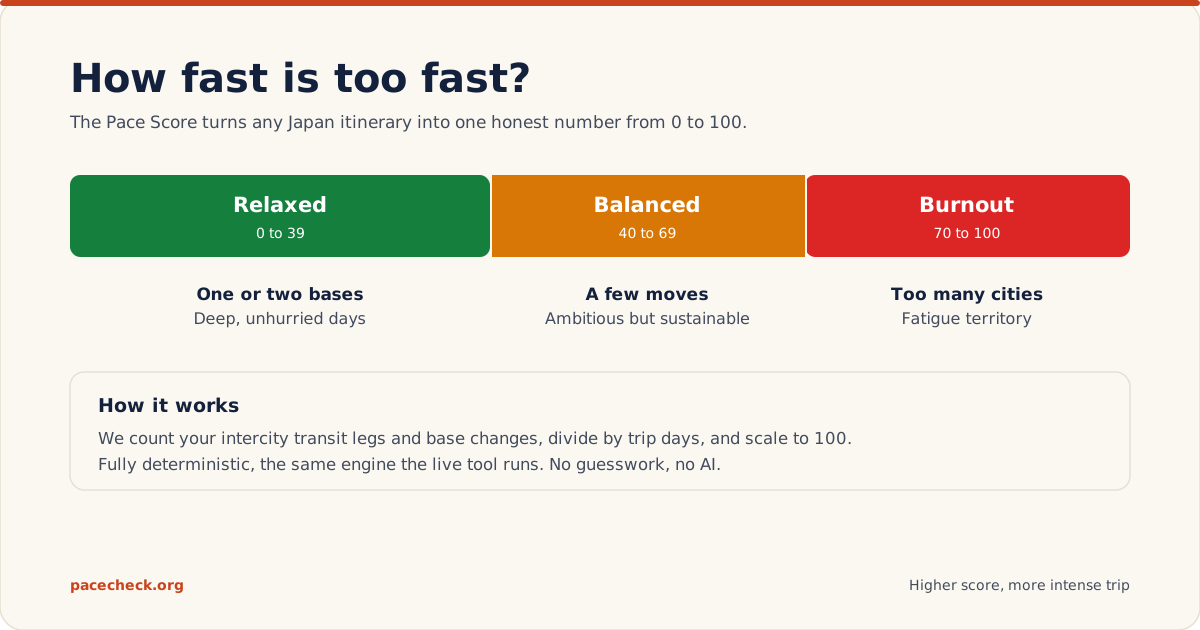
PaceCheck scores daily intensity from the ratio of intercity transit legs and base changes to total trip days. The more moves packed into fewer days, the higher the score climbs toward Burnout. Scores 0 to 39 are Relaxed, 40 to 69 Balanced, and 70 to 100 Burnout. A high score signals an aggressive, fatigue-prone schedule, not a healthy one.
Fares are indicative and confirmed on the provider's site; they can vary.
Credibility: fares were checked against official JR fare search on 2026-10-01.
Timing: the Pace Score and verdict are instant, computed in your browser, no waiting.
Freshness: JR ended its nationwide round-trip discount in March 2026, so round trips are now priced as two one-way tickets. From 1 October 2026 the 7 day ordinary pass costs 53,000 JPY through overseas travel agents, while the official JR Pass website lists 50,000 JPY.
Privacy: we do not store your itinerary, and no email is required.
We may earn a commission if you book through some links on this page, at no extra cost to you.
How the Pace Score is calculated
PaceCheck scores daily intensity from the ratio of intercity transit legs and base changes to total trip days. The more moves packed into fewer days, the higher the score climbs toward Burnout.
The formula is deterministic. We count T, the number of intercity transit legs in your itinerary, and H, the number of base changes (each move to a different city, including the trip home):
T = intercity transit legs · H = base changes (each move to a different city, including the trip home) · days = trip length
A trip with many legs and many base changes squeezed into a short window pushes the score upward. A trip anchored in one or two cities with few moves stays low.
The three bands are explicit: a score from 0 to 39 is Relaxed, 40 to 69 is Balanced, and 70 to 100 is Burnout. Higher always means more intense, never healthier. A Burnout score is a warning that the schedule is likely to cause transit fatigue, not a badge of efficiency. To compare these bands with practical routes, see 12 real itineraries scored by pace.
The hidden cost of changing cities
Every base change adds logistical overhead beyond the train ride itself: packing, checking out, hauling luggage to the station, navigating an unfamiliar station on arrival, and waiting until check-in time at the new hotel.
The Tokaido Shinkansen is the primary artery of the classic Golden Route. Tokyo Station to Kyoto Station is 513 kilometers. A reserved ticket on the Hikari service, which is fully covered by the standard Japan Rail Pass, takes about 2 hours and 40 minutes and costs 13,850 JPY for non-pass holders. The faster Nozomi service is a separate, faster option that is not covered by the standard JR Pass; pass holders who want Nozomi pay a supplement that varies by route and seat class, so we omit a fixed figure and recommend confirming on the JR ticket site at booking.
Walking volume compounds the problem. Exploring Tokyo and Kyoto can involve long days on foot. Stations like Shinjuku are subterranean labyrinths of stairs, and shrines like Fushimi Inari involve real incline hiking. Layer that on top of repeated check-outs and the high Pace Score days become the days travelers remember as exhausting.
7 day itinerary: one base wins
A 7 day trip rewards geographic discipline. Chaining Tokyo, Kyoto, Osaka and back to Tokyo into one week scores 43, the low end of Balanced. Adding Hiroshima raises it to 57, and five moves in seven days reach 71, Burnout. Anchoring in Tokyo and using regional rail for day trips keeps the score in the Relaxed band.
The most common structural failure for a seven day itinerary is compressing the standard 14 day Golden Route into a single week. Every added city adds one intercity leg and one base change, so T and H climb together against a fixed seven days: three moves score 43, four score 57, and five score 71, past the Burnout line at 70. A single urban base camp in Tokyo with targeted day trips to Kamakura or Hakone adds no intercity legs, which holds the score at the bottom of the Relaxed band.
10 day itinerary: two bases at most
A 10 day itinerary has room for two primary bases. A new hotel every 48 hours means five moves and a score of 50, mid Balanced. Splitting roughly five nights in Tokyo and five nights in Kyoto scores 10 to 20, comfortably Relaxed.
The optimized ten day itinerary caps base changes at two. Start with a five night block in Tokyo, take one Shinkansen relocation to Kansai, and use a five night base in Kyoto or Osaka. Nara, home to Todai-ji, is a 45 minute train ride from either, so it should be treated as a day trip rather than a third base. One or two moves across ten days keep T and H low relative to days, so the Pace Score lands at 10 to 20, in the Relaxed band.
Reducing friction with Takuhaibin luggage forwarding
The Japanese luggage forwarding network, known as Takuhaibin, takes the worst part out of a base change. Carriers ship a large suitcase between hotels within 24 hours, so you travel light on the day of the move.
Operated primarily by Yamato Transport, the service is highly reliable. Shipping a Size 160 suitcase (up to 25 kilograms) from a hotel in Kanto to Kansai is about 3,160 JPY. Hand the bag over the morning before you move, travel with a daypack on the Shinkansen, and the suitcase is in the new room by the next afternoon. It does not lower the Pace Score, but it makes Balanced and Burnout days physically survivable.
A prepaid Japan eSIM is one straightforward way to stay connected on arrival, and any reputable provider works. You can see one option.
Ready to check your own trip? Run your itinerary through the Pace Score calculator.
Frequently asked questions
What is a good Pace Score?
There is no single good score. The bands are 0 to 39 Relaxed, 40 to 69 Balanced, 70 to 100 Burnout. A first time visitor with limited stamina is usually happiest in Relaxed or low Balanced. An experienced traveler comfortable with daily moves can sustain mid Balanced. Scores in Burnout tend to predict fatigue regardless of fitness.
Does a higher Pace Score mean a better trip?
No. Higher means more intense, not healthier. A high score signals more intercity legs and more base changes per day, which compresses sightseeing time and increases travel fatigue. The score is a warning, not a goal.
How are intercity legs counted?
An intercity leg is one move between cities, typically a Shinkansen or limited express ride. A round trip Tokyo to Kyoto and back counts as two legs. Local subway rides, day trips that return to the same hotel, and walking do not count.
Is the Japan Rail Pass worth buying for a 7 day trip?
It depends on the legs. A 7 day Ordinary Japan Rail Pass costs 53,000 JPY from overseas agents since 1 October 2026, or 50,000 JPY on the official website. On a 3 leg Tokyo, Kyoto, Osaka loop, single tickets total about 28,830 JPY, well under either price. On a single base Tokyo trip with day trips, the pass is usually not worth it. Run the calculator with your exact legs to see the verdict.
Does luggage forwarding lower my Pace Score?
No. The score is determined by intercity legs and base changes only. Luggage forwarding does not change either count, but it removes the physical strain of hauling bags on transfer days, which makes Balanced and Burnout schedules more survivable.